
Salon suite client privacy is more than closing a door. It is the daily practice of creating a space where clients can speak comfortably, receive focused service, and trust how their personal details are handled. For an independent hairstylist, barber, esthetician, or nail professional, privacy can become a meaningful part of the client experience and a disciplined part of running your own business.
Explore private salon suite leasing options at Salons by JC
A private suite gives you more control over the physical environment, the service rhythm, and the way you communicate with clients. It does not automatically solve every privacy concern, though. The strongest approach combines intentional layout choices with consistent consultation, records, device, and operating practices.
Why does client privacy matter in a salon suite?
Client privacy matters because a beauty appointment often includes personal conversations, preferences, photographs, contact details, and treatment information. A salon suite can support discretion through a private setting, but the professional still controls what can be overheard, seen, stored, shared, or discussed. Treat privacy as part of the service standard, not an afterthought.
For an experienced beauty professional, privacy can improve the client relationship in practical ways:
- Clients can discuss goals, concerns, and service history without an audience.
- Consultations feel more focused because there is less traffic and interruption.
- Private conversations are less likely to become part of the broader salon environment.
- Photos and notes can be handled as business records rather than casual phone content.
- A clear policy gives you and your clients the same expectations every visit.
The Federal Trade Commission’s guide to protecting personal information recommends that businesses understand what information they keep, why they keep it, and how they protect it. You can apply that same practical mindset to a solo suite business without making unsupported legal promises. The goal is a repeatable operating standard that respects the client and protects your business.
How should you design a salon suite for privacy?
A privacy-focused salon suite uses the room itself to reduce unnecessary exposure. Start with the client’s path through the suite, then check what another person could see or hear from the door, hallway, neighboring space, reception area, or waiting area. The best layout supports conversation, service, and record handling without making privacy feel clinical or inconvenient.
Plan the sightlines
Stand at the entrance and look toward the styling chair, treatment table, shampoo area, retail shelves, and any place where you keep notes. Position chairs and work surfaces so a visitor at the door cannot casually view client conversations, consultation forms, phones, or computer screens. If the suite has a window, consider whether the angle exposes the client or the service to people outside.
Use the door intentionally
A closed or partially closed door can create a more discreet experience, but it should never interfere with safety, access, or the operating rules of the location. During a consultation, explain the level of privacy the suite offers and make the client comfortable asking for the door to be closed when appropriate. Keep the entrance clear so privacy does not create a trip or evacuation hazard.
Keep personal details out of the display area
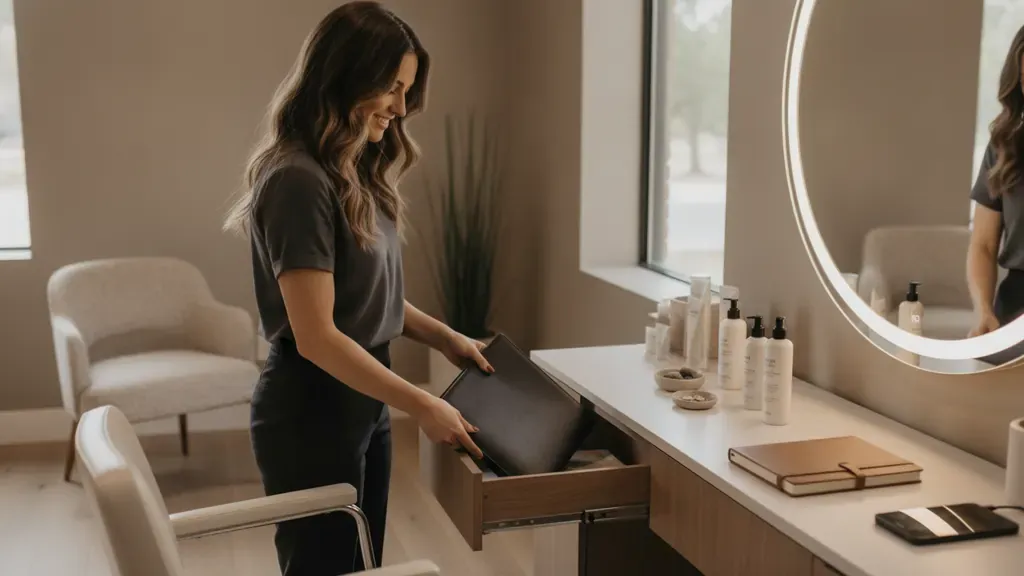
Do not leave consultation forms, appointment books, client lists, or personal messages on a counter where the next visitor can see them. Give every item a defined home. A small drawer, closed cabinet, or password-protected digital system is more reliable than remembering to hide paperwork at the end of a busy appointment.
When you tour a suite, inspect these details in person. Salons by JC promotes private, move-in-ready suites, secure 24/7 access, and a Full-Time Concierge Manager. Ask how the specific location handles access, visitors, deliveries, and shared areas so your privacy practices fit the space you are considering. Before signing, review the key terms in a salon suite lease agreement so your operating plan matches the space and the agreement.
How can you control sound and interruptions?
Sound control is a major part of salon suite client privacy. A closed door may reduce visibility while conversations still travel through walls, under doors, or into common areas. A practical sound plan includes the location of the suite, the timing of sensitive conversations, background noise, and a simple interruption protocol for visitors, deliveries, and neighboring activity.
- Listen before you lease: During a tour, spend several quiet minutes inside the suite and listen for hallway traffic, neighboring conversations, music, plumbing, and mechanical noise.
- Choose the right consultation position: Keep sensitive conversations away from the door and shared wall when the room allows it.
- Set a courteous volume: Speak clearly and calmly without assuming that normal conversation cannot be heard outside the suite.
- Use consistent background sound: Low, appropriate music or a sound machine may soften incidental noise, but it should never make communication difficult or create a disruptive environment.
- Build in pauses: If a delivery, visitor, or interruption arrives during a sensitive discussion, pause the conversation and confirm what the client wants to do next.
- Protect phone conversations: Take client calls inside the suite or in an approved private location instead of discussing client details in a shared hallway.
Privacy does not require silence. It requires awareness. A professional who knows where sound travels can choose a better consultation position, lower the music, wait for a hallway interruption to pass, or move a conversation to a more appropriate moment.
See the benefits of a private salon suite for your client experience
What should you cover during private consultations?
A consultation is where privacy becomes visible to the client. Begin by setting expectations: explain what you need to know, why it affects the service, and how the client can ask questions. Ask only for information that is relevant to the service or the safe operation of your business. Avoid turning a standard consultation into an unnecessary collection of personal details.
A consistent consultation flow can include:
- Service goal: Confirm what the client wants to achieve and what they want to avoid.
- Relevant history: Review prior services, products, reactions, or preferences that matter to the appointment.
- Comfort check: Ask how the client prefers to communicate, position themselves, and make decisions during the service.
- Photo conversation: Ask before taking a photo and distinguish a service record from a marketing image.
- Next-step agreement: Confirm the plan, products, maintenance, and follow-up without discussing the client in a public area.
Do not promise absolute confidentiality or make a legal guarantee that your business has not evaluated. Instead, use clear language: “I will use these details to plan your service and keep them in the business system I use for client records.” Your policy should match your actual tools and behavior. A polished statement that does not reflect reality creates less trust, not more.
If you work with an assistant, suite partner, or independent contractor, make sure everyone follows the same consultation expectations. A private suite can have a strong physical design and still lose client trust if one person repeats a conversation in a shared space.
How should you handle client records, photos, and devices?
Records privacy depends on the entire information path, from collection to storage, access, backup, sharing, and deletion. Decide where client information belongs before you need it. Then keep paper, phones, booking software, email, and photo storage aligned with the same rule. NIST’s small-business privacy guidance is a useful reference for thinking about data flows, risk, and responsible handling.
Client records should be easy for you to manage and difficult for an unintended person to view. Use these controls:
| Information area | Practical privacy control | Routine to adopt |
|---|---|---|
| Paper forms | Store forms in a closed, access-controlled location. | Return each form to storage immediately after use. |
| Digital notes | Use a reputable system with unique login credentials and device protection. | Lock the screen whenever you step away and review access settings. |
| Client photos | Separate service documentation from marketing content. | Ask before taking a photo and confirm the intended use before posting. |
| Messages and email | Keep client details out of casual or shared conversations. | Check recipients before sending and avoid unnecessary sensitive details. |
| Old records | Use a written retention and secure disposal routine. | Review what you still need and destroy paper securely when appropriate. |
Use multi-factor authentication where your booking, payment, email, cloud storage, or record systems support it. Do not share passwords between people. If you use a personal phone for business, enable a lock screen, keep software updated, and know where photos are backed up. If your phone is lost, a practiced response is more useful than a vague promise to “be careful.”
This is an operational checklist, not legal advice. Your obligations can vary based on your services, location, business structure, software, and the information you collect. When you are unsure about a specific requirement, ask a qualified legal or privacy professional to review your process.
How do you turn privacy into a clear operating policy?
A privacy policy for an independent beauty business should be short enough to use and specific enough to guide decisions. It should explain what information you collect, why you use it, where it is stored, who can access it, how photos are handled, and how clients can ask questions. Review the policy whenever you change booking, payment, messaging, or record tools.
Use this implementation checklist:
- Map the information: List the details you collect in consultations, bookings, payments, notes, photos, messages, and marketing.
- Remove excess collection: If a detail is not needed for the service or a defined business purpose, do not collect it simply because a form includes a blank.
- Define access: Identify who can see records and remove access that is no longer needed.
- Write the client-facing explanation: Use plain language and make it available where information is collected.
- Separate photo uses: Treat service records, before-and-after documentation, social media, and advertising as different decisions.
- Practice a response: Decide what you will do if a device is lost, a message goes to the wrong person, or a client asks how their information is used.
- Review quarterly: Check the policy against the tools and habits you actually use.
Think of the policy as a business operating system. It should help you make the same careful choice when the day is calm and when the schedule is full. A premium suite environment supports that standard by giving you a professional space to control the client experience. The policy is what makes the standard repeatable. If you are building toward independence, this guide to becoming a salon suite owner can help you think through the broader business transition.
Book a tour to evaluate a private salon suite for your independent business
Frequently Asked Questions
What is salon suite client privacy?
Salon suite client privacy is the combination of physical design, sound awareness, consultation habits, records handling, and operating policies that help a client receive services discreetly. A private suite can support privacy through a separate room and controlled access, but the professional still needs routines for conversations, photos, devices, forms, and digital records.
Does a private salon suite guarantee client confidentiality?
No. A private suite can reduce visibility and interruptions, but it does not guarantee that every conversation or record is confidential. Sound can travel, devices can be misplaced, and people can make inconsistent choices. Set practical expectations, limit access to records, protect devices, and use a written policy that matches your actual business practices.
Where should I keep client consultation forms?
Keep paper consultation forms in a closed, access-controlled location that is not visible to other clients or visitors. Return each form to storage after use instead of leaving it on a workstation. If you use a digital system, protect the account with unique credentials, a lock screen, and multi-factor authentication when available.
Should service photos and marketing photos be handled differently?
Yes. A photo used to remember a service detail is a different business decision from a photo used on social media or in advertising. Ask before taking either type of photo, explain the intended use, and store the image in the appropriate system. Do not assume that permission to document a service also means permission to publish it.
What should I look for when touring a salon suite?
Check the door, sightlines, neighboring walls, hallway traffic, windows, shared areas, storage, internet access, and the location’s visitor and delivery routines. Spend a few quiet minutes inside the suite to listen for sound transfer. Ask the Concierge Manager how access and common-area activity work at that specific location.
How often should I review my privacy practices?
Review your privacy practices at least quarterly and whenever you change booking, payment, messaging, photo, or record systems. Also review them after an incident, a lost device, a mistaken message, or a change in who helps operate your business. A short recurring review keeps the written policy aligned with the tools you actually use.
Privacy is one of the ways an independent beauty professional can make a suite feel intentional, personal, and professional. When the layout, sound control, consultation flow, record routine, and policy all support one another, clients can feel more comfortable while you build a business around your own standards.