
Private Treatment Room for Rent: A Pro’s Guide
At a certain point, sharing a station starts to limit more than your setup. It can put privacy, scheduling, storage, and the client experience out of your control, even when your practice already draws steady demand. A dedicated room gives you the foundation to serve clients on your own terms and build a real business around your own standards.
Tour a private treatment room suite
A private treatment room for rent gives a licensed esthetician or spa professional greater privacy, stronger brand control, and more ownership of every client interaction. It is also a practical stepping stone toward full suite independence, where you control the schedule, the pricing, and the environment.
The right choice depends on more than whether a room is available. You need to evaluate how a space supports your services, your safety requirements, your income goals, and your next stage of growth. Start by comparing the professional and business advantages of a private room with the compromises of a shared station.
What Should a Private Treatment Room for Rent Include?
A private treatment room for rent should give you enough space for your table and workflow, plus running water, organized storage, a dedicated sanitation area, adjustable lighting, and proper ventilation. These essentials should all be secured behind a door that protects your client’s privacy. Together, they let you deliver services safely and consistently while you build toward suite independence.
Before you sign a lease, picture your complete client flow: welcoming the client, consulting privately, moving to the treatment table, reaching products and tools, completing the service, and resetting the room. Research on clinical workspace design shows that layout and workflow deserve deliberate attention. The same principle applies to a private treatment room, where efficiency shapes the client experience and how many services you can manage in a day.
Room size and treatment-table clearance
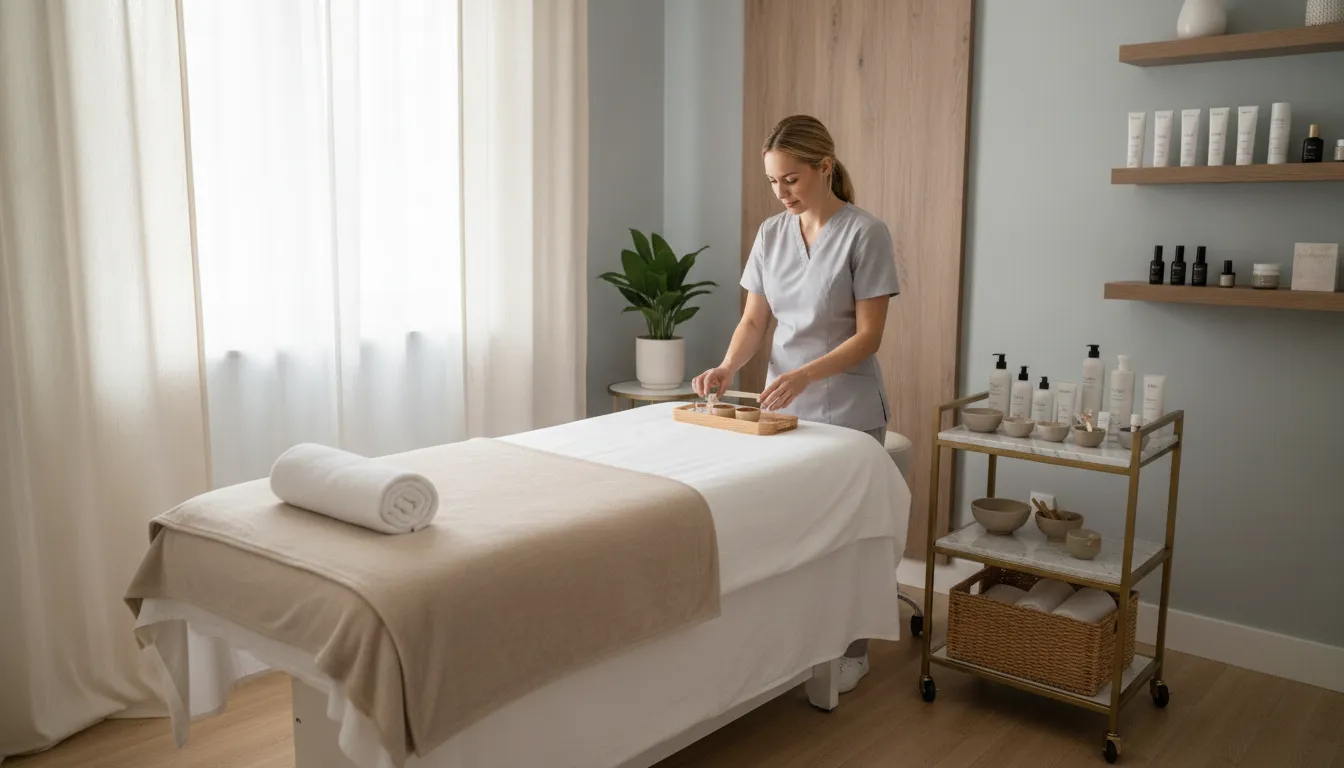
Start with enough square footage for your treatment table, stool, rolling cart, and yourself to move safely around the client. You should be able to reach the head, sides, and foot of the table without twisting around furniture or asking a client to reposition. Leave a clear path to the door and avoid filling usable floor space with display pieces. Map the room around the services you actually perform instead of choosing a space based only on its monthly price.
Water, storage, and sanitation
A sink with running water is a practical baseline for many esthetics workflows. Confirm its location, hot and cold water access, drainage, and whether the arrangement meets your state and local requirements. Nearby storage should hold clean linens, gloves, disposables, back-bar products, and equipment without placing supplies on the floor or beside used materials. Closed cabinets are usually more useful than attractive but exposed shelving.
Plan a dedicated sanitation station that separates clean supplies from items awaiting cleaning. It should offer a stable surface for the products you use and leave enough room to follow manufacturer directions for contact time. The OSHA Bloodborne Pathogens Standard is one reference point for managing exposure risks, sharps, and protective practices. Your state board may add specific sanitation requirements, so verify them before you open.
Lighting, ventilation, and client-ready details
Good lighting lets you assess skin accurately without creating glare in your own line of sight or making the client uncomfortable. Use adjustable task lighting for different services while keeping cords secured and walkways clear. Adequate ventilation matters for comfort and for products with noticeable vapors. Ask how the building handles airflow if you use wax, peels, or other products that require careful environmental control.
Finally, reserve a small, organized retail shelf for products that genuinely support your clients’ home care, and keep it curated rather than crowded. Change table coverings between clients and keep draping secure while preserving comfort and dignity. These details communicate the level of care your business is known for, and an intentional layout gives you the control to deliver it consistently.
Why a Private Treatment Room for Rent Beats a Shared Station
For an experienced esthetician, moving from a shared station to a private room is a business decision. It puts your client relationship, daily schedule, and next stage of growth under your control. A private treatment room for rent gives you a defined professional environment where your practice operates as its own business rather than as one appointment slot inside someone else’s floor plan.
Give clients privacy they can feel
Facials, waxing, and corrective skin treatments often involve personal conversations, close contact, and moments when a client needs to feel completely at ease. In an open station, nearby conversations, foot traffic, and competing music can make that harder. A dedicated room creates a more exclusive experience and gives clients confidence that their time, questions, and treatment are receiving your full attention. That privacy strengthens trust, which matters when you ask clients to follow a treatment plan or return for a series of services.
Own the schedule and the economics
Shared stations can make your availability depend on a salon’s hours, floor traffic, or general operating rhythm. A private room lets you design a schedule around the way you actually work. You can protect setup and sanitation time, group appointments more intelligently, reserve space for consultations, and decide when expanding your hours makes business sense. That control also supports more deliberate pricing, because you evaluate your menu, retail strategy, rebooking process, and monthly room cost as parts of one business model.
Make the room part of your brand
Your clients should recognize your practice before they see your name on a booking confirmation. In a private room, you can make thoughtful decisions about lighting, music, scent, linens, storage, and how products are presented. You can create a calm environment that reflects your specialty instead of adapting your service to a shared station’s fixed setup. The result is a consistent experience that helps clients understand what makes your practice worth choosing and recommending.
Use independence as the next business step
A private room is a practical platform for building an independent client base. It helps you grow without taking on the responsibilities of owning an entire facility. You can refine your systems, strengthen retention, and decide which services deserve more space as demand develops. Before signing, review suite lease types carefully so the room, terms, and support structure match the business you are trying to build.
How to Budget for a Private Treatment Room
The monthly rent for a private treatment room varies by market, amenities, and lease terms. The right number for you depends on local conditions rather than a single national figure. Ask each landlord for the full monthly rate plus every cost that arrives with it, then compare spaces on total cost rather than advertised rent alone.
Plan for the move-in amount, not just monthly rent
Your first payment will often be higher than the advertised monthly rate. Ask whether the agreement requires a security deposit, first month’s rent, an application fee, an administrative fee, or other move-in charges. Confirm which amounts are refundable, whether utilities and internet are included, and what happens to those charges when your lease ends.
Build a complete opening budget that lists monthly rent, deposits, utilities, business insurance, booking software, laundry, supplies, merchant fees, equipment, and any signage or opening marketing. Review what is typically included in a salon suite rental so you know which items the room provides and which ones you must supply yourself.
Compare the room against the revenue you keep
The monthly rent matters only in relation to what you keep. In a commission arrangement, a percentage of every service goes to the salon. A flat monthly rent lets you keep more of each service you deliver once the room is covered. As a result, the math works best when your client volume is steady and your pricing supports the fixed cost. Model a conservative month that includes time off and slower seasons, and review how much salon suite owners typically earn to gauge a realistic range for your market.
Location is one of the biggest variables. A room near a dense residential area, strong commercial corridor, or established client base may cost more than a room in a smaller market. The premium can still make sense if it reduces commute friction, supports repeat visits, and puts your business closer to the clients you want to retain. Browse Salons by JC locations to compare markets and identify spaces that fit your service area.
Hourly Room or Full Suite? A Quick Comparison
Before you commit, decide whether an hourly room or a full suite lease fits the business you are building. Both give you a private space, but they differ in commitment, cost structure, and how much control you keep over the environment.
| Consideration | Hourly Rental Room | Full Salon Suite Lease |
|---|---|---|
| Leasing commitment | Book only the time you need. Works well for occasional appointments, pop-up services, or early testing without a long-term lease. | Sign a fixed-term agreement and establish a consistent base for your daily or weekly schedule. |
| Cost structure | Pay by the hour or booking period. You avoid major upfront buildout costs, but repeated bookings can become hard to forecast. | Pay a predictable monthly rent. Initial costs may be higher, yet recurring expenses are easier to model as client volume grows. |
| Privacy and brand ownership | Privacy depends on the room and venue, and the environment may not consistently reflect your visual identity. | Use a private setting that fully supports your brand, client rituals, service menu, and professional identity. |
| Control over environment | Work within the host’s hours, policies, furnishings, lighting, storage, and room setup. | Shape the environment around your treatments, workflow, client comfort, schedule, and service standards. |
| Buildout and equipment | Lower setup responsibility is a clear advantage for flexible early-stage use. | Review what is included, then add the equipment and furnishings that make the room function as your practice requires. |
| Client-building | Useful for proving demand or serving a short-term roster without maintaining a permanent room. | A consistent address makes it easier to build repeat visits, referrals, retail habits, and long-term relationships. |
Choose based on the business you are building
Hourly rental is not a lesser option. It is practical when your demand is irregular, your service is newly launched, or you need flexibility while deciding what comes next. Track your booking frequency, travel time, setup effort, and total monthly spend rather than judging the model by hourly price alone.
When appointments become consistent, a full suite is the clearer step toward independence. You gain a reliable setting where your business can look, feel, and operate like your own. A monthly lease also gives you room to refine the client experience instead of adapting every appointment to someone else’s schedule. For licensed professionals ready to make that transition, a dedicated salon suite can provide the structure and support to grow without the burden of owning an entire facility.
Step-by-Step: Transition to Your Own Treatment Room
Moving into a private treatment room is a business decision, not simply a change of scenery. Use the transition to test the economics, protect your professional standards, and create an experience your clients will recognize as distinctly yours.

- Audit your volume and revenue. Review the last six to twelve months of service revenue, appointment volume, rebooking rate, cancellations, retail sales, and average ticket. Compare what you currently keep under a commission split with the fixed monthly rent you are considering.
- Choose the right rental structure. Decide whether an hourly room gives you enough consistency or whether a full suite lease better supports your schedule and brand. Review the differences in suite lease types before committing.
- Build the complete move-in budget. List monthly rent, security deposit, first payment, utilities, insurance, booking software, laundry, supplies, merchant fees, equipment, and any signage or opening marketing. Compare total cost across the spaces you tour.
- Equip the room around your workflow. Start with a professional treatment table, adjustable task lighting, a stool, covered storage, a sanitation area, linens, and service-specific tools. Arrange supplies so you can move safely and reset efficiently between appointments.
- Confirm your licensing and insurance. Verify that your esthetics license and any required business insurance are active for the new location, and confirm the room meets your state board’s sanitation rules. If you are in New Jersey, review NJ license requirements for salon suite rental to stay compliant.
- Announce the new address and rebook intentionally. Give established clients clear notice well before opening. Update your booking page, confirmation messages, social profiles, email signature, and local listings, then personally invite priority clients to rebook at the new address.
- Book a suite tour. Walk through the room, building access, amenities, lease terms, and the support available to independent professionals. Salons by JC is built around independent business ownership, with professional support for licensed beauty professionals. A tour lets you assess whether the space can support your services.
See a private treatment room suite and compare your options
Frequently Asked Questions
What are the benefits of renting a private treatment room for estheticians?
A dedicated room gives you control over privacy, scheduling, lighting, music, branding, and the overall client experience. It also creates a more consistent setting for specialized services and gives you a practical path from working inside someone else’s business to building your own.
Is a private treatment room better than booth rental?
That depends on your business model, but a private room is usually the stronger fit when client privacy, environmental control, and brand presentation matter. Unlike a shared booth, a dedicated room lets you shape the experience around your services and schedule while building a distinct professional identity. Read more in our guide to booth rental vs. salon suite.
What should I look for when searching for a private treatment room for rent?
Confirm that the room supports your services with adequate treatment space, water access, storage, lighting, ventilation, sanitation capacity, and secure client privacy. Review the lease, utilities, insurance expectations, access hours, maintenance responsibilities, and licensing requirements before committing. A tour can reveal workflow limitations that a listing will not.
How do I budget for a private treatment room?
Compare the total first payment, which includes rent plus any security deposit and fees, against the revenue you keep per service. Build a realistic monthly budget for utilities, insurance, supplies, and equipment, then confirm which items the room provides. A flat monthly rent makes sense when steady client volume supports the fixed cost.
Explore private treatment room leasing options
Ready to Move Into Your Own Treatment Room?
A private treatment room can give you more control over your client experience, schedule, and professional identity as you build toward full suite independence. Take the next step by learning how Salons by JC can support your transition into a dedicated space designed for licensed professionals.