
Why Private Salon Studios for Rent Support Independence
Moving from commission or booth rental into your own studio is a business decision, not simply a change of address. Private salon studios for rent give experienced licensed beauty professionals a defined place to serve clients, manage their schedule, and build a business around their own name.
Explore salon suite leasing options
Private salon studios for rent are individual, client-ready workspaces where a licensed hairstylist, barber, esthetician, or nail professional can operate independently inside a professionally managed facility. The model generally replaces a commission split with predictable rent, while giving the professional more control over pricing, scheduling, products, and the client experience.
The right studio should support the services you already perform and the business you want to build next. Use the guide below to evaluate the room, the facility, the lease, and the level of responsibility before you commit.
How to Evaluate Private Salon Studios for Rent
Evaluate a private studio as the operating base for your business, not as a decorated room. Location, client flow, equipment, management support, access, and lease obligations all affect whether the space can support a reliable day of services and a professional client experience.
Start with the location and client journey
Consider how existing and prospective clients will reach the facility. Check visibility, parking, building access, nearby businesses, and the route from the entrance to your studio. A polished room loses value if clients cannot find it, park conveniently, or enter during your preferred appointment hours.
Walk through the client journey during your visit. Is the entrance welcoming? Is there a clean waiting area? Can clients move through common spaces without crossing active service areas? Think through arrival, consultation, service, payment, rebooking, and departure. This exercise often reveals practical issues that photos and listing descriptions do not show.
Inspect support beyond the studio door
Ask who handles common-area maintenance, security, utilities, building communication, and equipment concerns. A managed facility may provide on-site management, concierge support, and equipment assistance, but inclusions vary by location and agreement. Request the current list in writing and confirm what remains your responsibility.
Inside the room, check the chair, mirror, sink or shampoo setup, storage, outlets, lighting, ventilation, and any equipment you plan to bring. Ask which customizations are permitted, which improvements require approval, and who pays for repairs. A studio can look attractive and still be inefficient for your service workflow.
Review lease readiness before signing
Clarify rent, term, renewal, deposit, included services, access hours, insurance expectations, maintenance, signage, and move-out requirements. Review salon suite lease terms as a checklist, then request the actual agreement for the location you are considering.
Finally, assess whether your business systems are ready. You should be prepared to manage bookings, pricing, client communication, records, marketing, product choices, and applicable compliance obligations. Independence is most useful when the systems behind it are dependable.
What Makes a Private Studio Client-Ready?
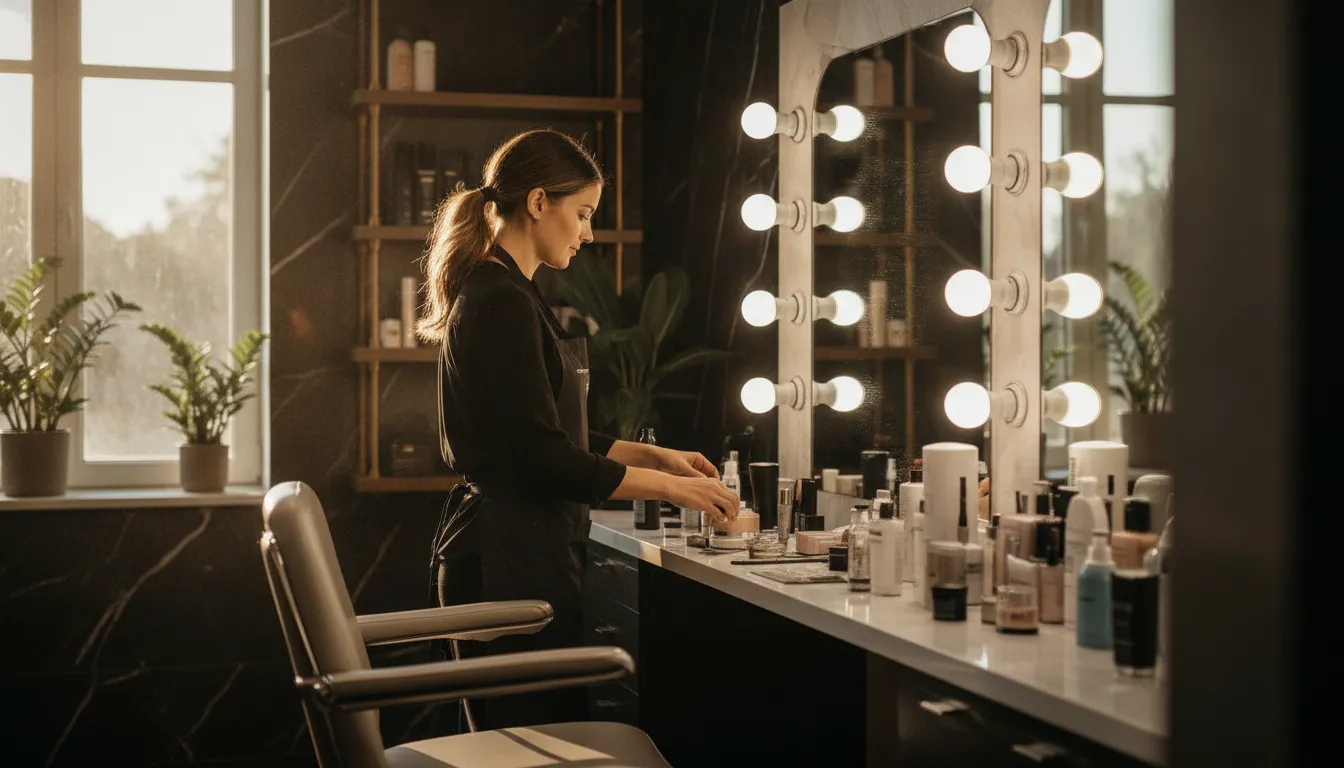
A client-ready studio combines functional equipment, a comfortable service flow, clear privacy, and dependable facility support. The room should let you deliver your core services efficiently while giving clients a polished experience from arrival through rebooking. Confirm the actual setup at the location instead of relying on a standard description.
Match the setup to your service menu
Inspect the studio as if you were serving a full day of clients. A hairstylist may need a styling chair, mirror, color station, shampoo access, and product storage. A barber may prioritize chair clearance, tool organization, and a practical sanitation area. An esthetician may need a treatment bed, rolling cart, sink access, and task lighting. A nail professional should consider table placement, electrical access, ventilation, and sanitation storage.
Ask which fixtures and equipment are included, which items you supply, and how repairs are handled. Salons by JC describes its suite model as providing professional amenities, equipment support, concierge services, and on-site management. Confirm the current scope directly because equipment, fixtures, access, and support can vary by location.
Evaluate privacy and shared spaces
Privacy matters because consultations and services should feel personal. Look at the door, sound levels, neighboring studios, waiting area, restrooms, and shared corridors. A private room should also be easy to find and comfortable for clients carrying coats, bags, or retail purchases.
Verify practical infrastructure before you decide. Ask whether utilities and WiFi are included, how access works outside standard hours, what security procedures apply, and who handles building maintenance. The facility can reduce logistical friction, but it cannot replace a layout that works for your specific services.
Use a written readiness checklist
Use the suite rental inclusions guide to prepare questions, then confirm each answer during the tour. Bring your service menu and sketch a typical appointment. Note where the client sits, where tools are placed, how products are reached, and how used materials move to the sanitation area.
- Service equipment: Confirm chairs, sinks, shampoo fixtures, treatment surfaces, lighting, and electrical access.
- Storage: Plan homes for tools, linens, products, retail stock, and cleaning supplies.
- Client comfort: Check privacy, seating, temperature, sound, lighting, and movement.
- Operations: Confirm access, WiFi, utilities, security, maintenance, and facility support.
How Much Do Private Salon Studios Cost?
The cost of a private studio depends on market, size, fixtures, included services, and lease terms. A flat weekly or monthly rent makes the primary occupancy cost easier to model than a percentage split. But you still need to budget for supplies, insurance, software, payment processing, taxes, marketing, and slower booking periods.
Company pricing information places Salons by JC studios at approximately $230 to $300 per week, with an average of $259.50 per week in the provided business context. These figures are not universal rates or a quote. Confirm current pricing, availability, deposits, inclusions, and renewal terms with the location.
Calculate your break-even point.
Use a simple comparison to understand when flat rent may become more efficient than a percentage-based arrangement:
Break-even service revenue = weekly studio rent divided by the percentage paid under the alternative model.
For example, $259.50 in weekly rent divided by a 50% commission rate equals $519 in weekly service revenue. Above that point, the flat rent may leave more service revenue before other expenses. Replace the example figures with your own rent, split, service mix, product cost, taxes, and payment fees. This is planning math, not personalized financial advice.
Budget for the full move-in picture
Rent is only one line in the transition budget. Ask about deposits, prepaid rent, first payment, utilities, WiFi, laundry, cleaning, waste removal, equipment, insurance, booking software, retail inventory, and marketing. Salons by JC business information indicates that its studio arrangement may require an upfront amount equivalent to two months. Confirm the exact amount and refundable conditions directly.
Build a conservative monthly forecast before you sign. Start with expected appointments, average ticket, product usage, and collection timing. Then subtract rent and every operating expense. Model a slower month as well as a full month. A studio should fit your cash flow, not only your best-case revenue.
Ask these cost questions in writing
- What is the current weekly or monthly rent, and when can it change?
- What deposit or prepaid rent is required, and how is it returned?
- Which equipment, utilities, amenities, and maintenance services are included?
- What are the lease length, renewal, cancellation, and notice provisions?
- Which insurance, licensing, cleaning, product, software, and tax costs remain mine?
Compare the complete monthly picture with your current commission or booth arrangement. The goal is not to find the lowest advertised rent. It is to choose a structure that matches your volume, reserves, service mix, and preferred level of control.
What Studio Size Fits Your Services?
The best studio size is the smallest space that supports your busiest service without creating unsafe or awkward movement. Compare usable floor area, fixtures, storage, door swing, plumbing, outlets, and client clearance. A larger room is not automatically better if the extra space adds cost without improving your workflow.
Salons by JC business information lists standard studios at approximately 90 to 150 square feet, with single studios generally 90 to 120 square feet. Double studios 130 to 150 square feet, and premium corner studios starting at 150 square feet. Treat these as planning ranges, not a promise of inventory at every location.
Size the room around the hardest service
A stylist focused on cuts and blowouts may need less space than a professional who performs color, extensions, or shampoo services. An esthetician should account for a treatment bed, rolling cart, sink access, and clearance around the client. Nail professionals should plan for the table, two seats, ventilation needs, products, and sanitation supplies.
If you offer several services, size the room around the largest equipment footprint and the service requiring the most movement. Do not measure only wall to wall. Record usable space after fixtures, storage, and door clearance are considered.
Test movement, storage, and sanitation
During a tour, sketch your busiest appointment and test the sequence. Can you reach tools without turning away from the client? Can a client sit, stand, and place personal items comfortably? Do clean and used materials have separate, practical homes? Storage should keep backstock and retail products organized without occupying the service path.
- Measure wall-to-wall dimensions and usable floor area.
- Record door, sink, shampoo, outlet, and plumbing locations.
- Estimate clearance around the chair, table, bed, and primary work zone.
- Identify storage for tools, linens, products, retail, and sanitation supplies.
- Ask whether fixtures or layout changes can be customized.
Use this information to compare studios by function rather than appearance. A compact room can work well when every station has a purpose. A larger room may be justified when your service menu, equipment, or client flow genuinely requires it.
Private Studio vs. Booth Rental: Which Fits Your Business?
Private studio leasing and booth rental can both support an experienced beauty professional. The meaningful difference is the balance between control and responsibility. Booth rental may preserve a shared environment and simpler transition, while a private studio creates a defined setting for your brand, schedule, pricing, and client relationship.
| Business factor | Private studio leasing | Booth rental |
|---|---|---|
| Payment | Usually a flat rent, with service revenue retained after expenses. | May be a fixed fee or percentage arrangement, depending on the agreement. |
| Schedule and pricing | You set hours, appointments, prices, and policies around your clientele. | The shared environment may shape hours, traffic, or operating expectations. |
| Brand and privacy | A private setting supports a distinct visual identity and client experience. | A shared setting may provide less control over surrounding presentation. |
| Business ownership | You manage booking, marketing, products, records, rebooking, and compliance. | Shared infrastructure may reduce setup work while limiting autonomy. |
| Facility support | Managed facilities may provide concierge, maintenance, or equipment support. | Support depends on the salon owner and specific rental agreement. |
Compare the numbers, then compare the control
Some industry comparisons describe commission arrangements at roughly 50% to 70% splits and chair or booth rental as a percentage of gross revenue. These broad ranges vary by market and agreement, so do not treat them as universal rates. Use your actual contract and monthly numbers.
Ask what you gain beyond revenue retention. Can you set prices without approval? Protect your schedule? Choose products that fit your standards? Build a client list connected to your name? If those controls matter and your bookings can support predictable rent, a private studio may fit your next stage.
Choose the responsibility level you can sustain
Independence does not mean managing an entire building. A professionally managed facility may handle common-area operations while you own the decisions that shape your company. You remain responsible for service quality, client communication, policies, pricing, marketing, and applicable business obligations.
How Do You Build Your Brand in a Private Studio?
A private studio gives your business a physical home and a consistent setting for the client experience. Brand building starts before move-in with clear positioning, a focused service menu, reliable policies, and communication that makes the transition easy for existing clients.

Make the experience recognizable
Define your business name, visual direction, service promise, and ideal client. Apply those decisions across studio details, booking pages, social profiles, business cards, email, and aftercare materials. A consistent experience does more for recognition than filling the room with decorations that do not support your positioning.
Review your service menu at the same time. Give each service a clear name, description, duration, price, and preparation note. Keep the menu focused on the work you do best and the outcomes your clients value. In a private studio, your pricing and product choices become visible parts of your brand.
Set policies before announcing the move
Write policies for deposits, cancellations, late arrivals, consultations, payment methods, and retail returns. Make them easy to find during booking. Then create a communication sequence that confirms the new location, parking, access, what will feel different, and how clients can prepare for their first visit.
Use your own booking and follow-up process so the relationship remains connected to your business. After the appointment, provide relevant aftercare and a clear rebooking path. The facility can support your environment, but your systems create consistency.
Use support without outsourcing ownership
Concierge services, on-site management, and equipment support can reduce facility logistics. They do not replace your responsibility for marketing, bookings, pricing, client relationships, or service standards. Use support to spend more time on the work only you can do: serving clients, improving retention, and developing your professional reputation.
Explore private salon studio leasing options for your business
Frequently Asked Questions
What should I confirm before choosing a private studio?
Confirm the total rent, deposit, lease terms, included equipment, utilities, WiFi, storage, access hours, security, maintenance, cleaning responsibilities, and facility rules. Then test the room against your service menu and client flow. Ask for location-specific answers in writing before you sign.
How do I know what studio size I need?
Start with the services you perform most often, then account for equipment, storage, movement, sanitation, and client comfort. A compact room can work for a focused service menu. Shampoo equipment, treatment beds, multiple stations, or extensive inventory may justify more space. Test the layout in person.
Is a private studio better than booth rental?
It depends on your priorities, numbers, and operating style. A private studio generally gives you more control over schedule, pricing, products, privacy, and client relationships. Booth rental may suit a professional who prefers a shared environment or simpler transition. Compare the complete costs and responsibilities.
What does running my own studio business require?
Independence requires clear booking and cancellation policies, a focused service menu, pricing, client communication, marketing, product choices, payment processes, records, and compliance with applicable local requirements. A managed facility can support the setting, but you remain responsible for the business decisions and client experience.
Ready to Explore Your Private Studio Options?
A private studio can give you a deliberate setting for serving clients, managing your schedule, and building a business around your professional identity. Compare the full economics, inspect the actual room, review the agreement, and choose the level of support that helps you operate with confidence.